
The most translated female author of German fiction
Women writers in the German National Library
We invited Lisa Teichmann to write a guest post for our substack because her interests are in many ways parallel with our own.
Lisa is a postdoctoral fellow at the Research Group Visualization and Data Analysis at the University of Vienna. Her research is dedicated to making women writers and their translations visible in national collections. In this post, based on her 2025 article “Translationalism and the gender gap in the German National Library: a case study for women writers,” she discusses some of her findings.
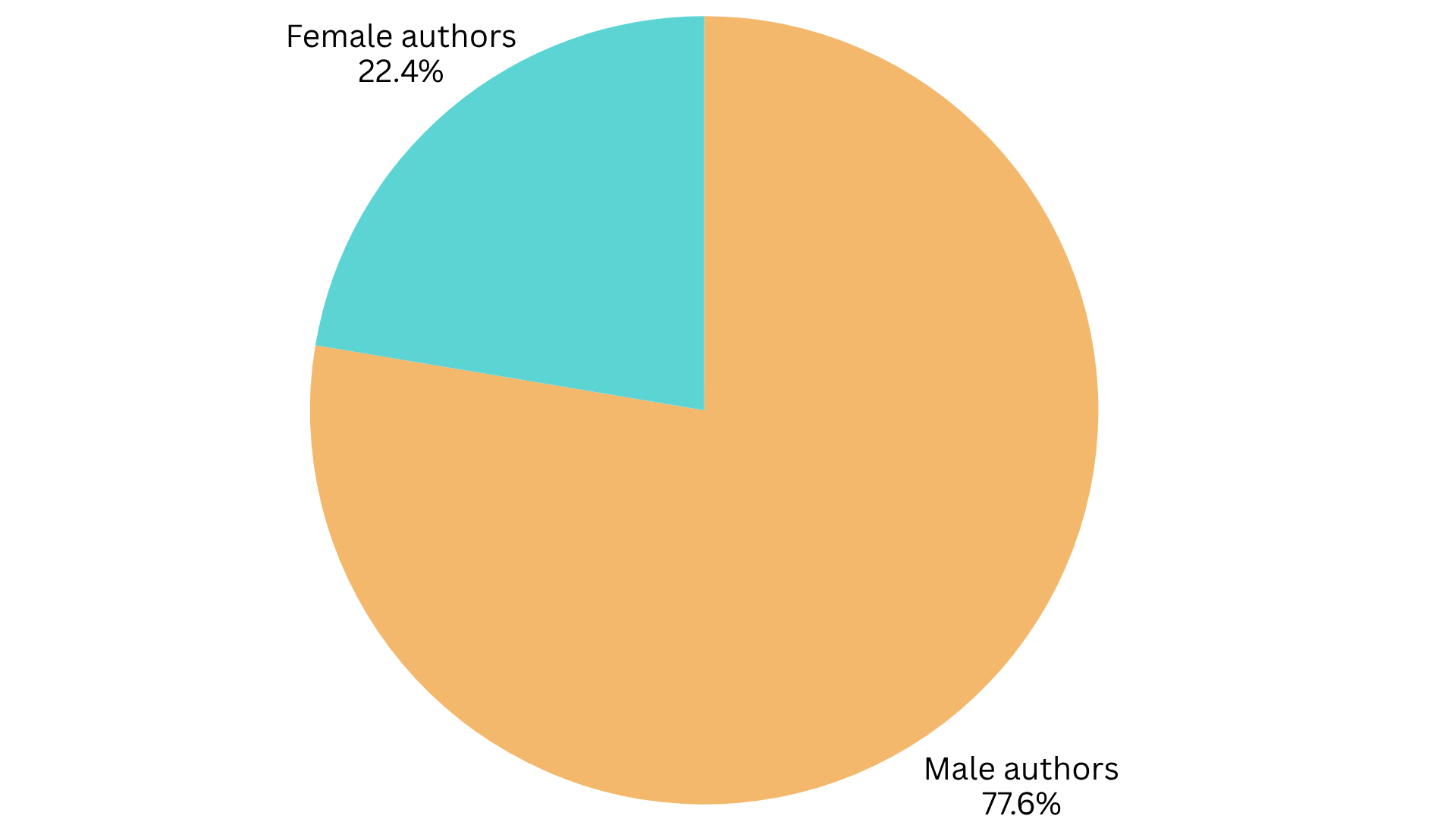
When I was writing my dissertation, I discovered that only 22% of all German fiction translations in the German National Library (Deutsche Nationalbibliothek: DNB) are by women. This came of no surprise, since the gender gap is a common phenomenon in literary canons. Whether it be bestseller, must-read lists, or book prizes, the numbers are always more or less the same. Die Deutsche Welle—an online news outlet and popular resource for German language learners—published a list of 100 must-read German works in translation. Not surprisingly only a third of the titles are by women writers. Only 14.28% of 119 writers who were awarded the Nobel Prize of literature are women. Bestselling and midlist author also remain predominantly male.1
My dissertation’s dataset also reflected a similar bias: only 1,742 writers identify as female according to the standardized authority files (GND) of the German National Library (DNB) catalog, representing 22.4% of all 6,047 authors in the “Mapping German fiction in translation” dataset. If you are wondering how you can get the data, check out this blog post for a 3-step guide!
While it is a humbling discovery, I quickly turned my attention to the 1,742 women writers in my dataset. Who are they? What makes them so prominent in translation and in the DNB’s collection? Which reader communities did they reach through their works?
Who are the most translated women writers in the DNB?
First, I started at the top 10. I expected to see names like some of the Nobel prize winners, such as Herta Müller, Elfriede Jelinek, or Nelly Sachs, all of which appear in bestselling lists and recommended book lists internationally alike.
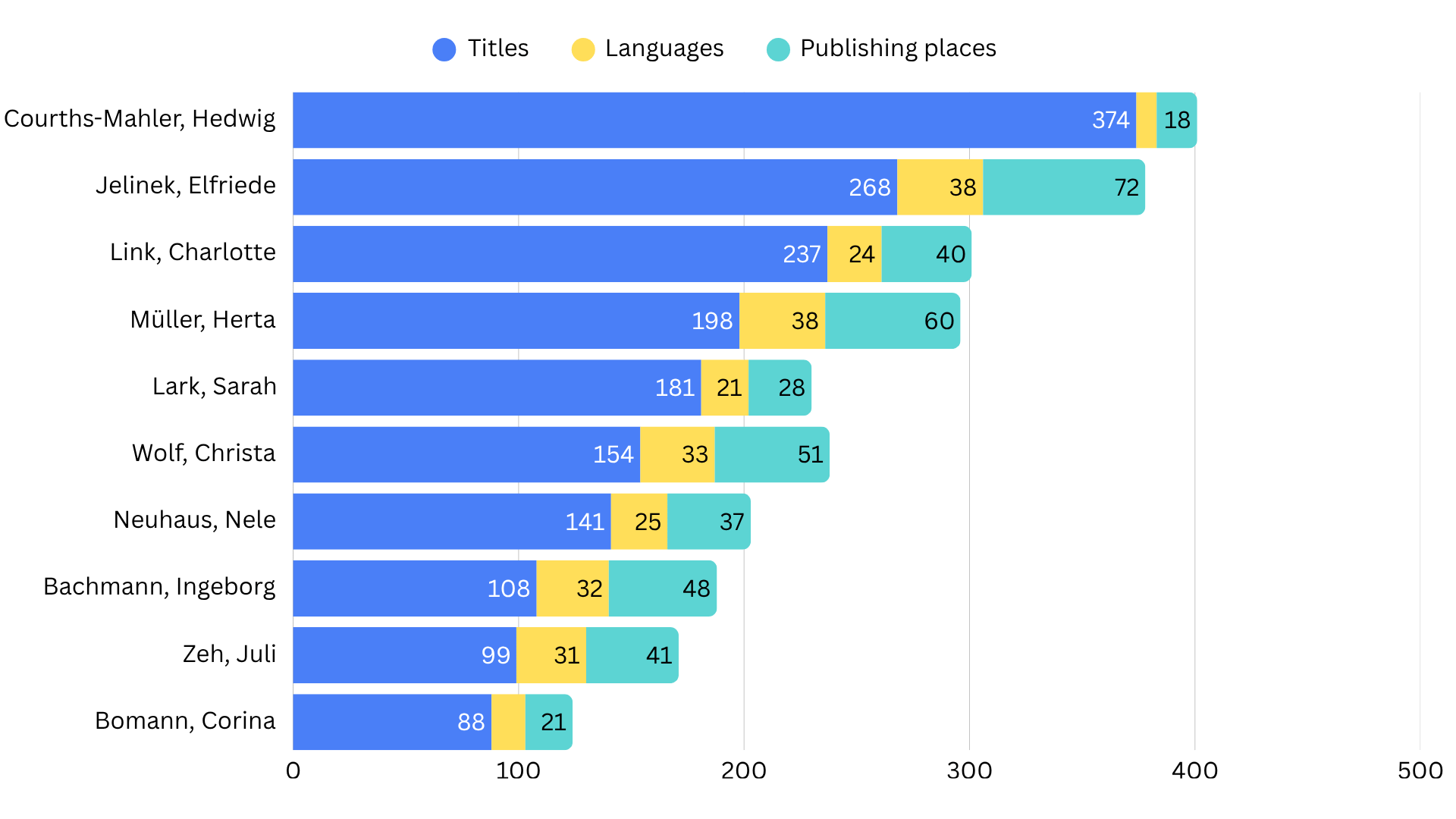
A quick look at the authors on the left side of the figure, with the most translated titles (blue bar), reveals these internationally well-known prize winners, mixed with more contemporary bestselling authors of psychological fiction (Charlotte Link), crime fiction (Nele Neuhaus), and children’s / young adult literature (Sarah Lark).2
Hedwig Courths-Mahler, the most translated author?
However, the most translated was Hedwig Courths-Mahler, an author I have never heard of. I asked around and neither have my fellow postdocs and German studies scholars. Who is she and why is she so popular in translation?
Ernestine Friederike Elisabeth Mahler, later Hedwig Courths-Mahler (1867–1950) published over 200 romance novels, many issued as dime novels that achieved great success during her lifetime, especially during the Weimar Republic. Not only was she a highly productive author with an output of more than 4 novels a year, but she also achieved sales of over a million sold copies. Her success also resulted in several film adaptations in the 1920s.3
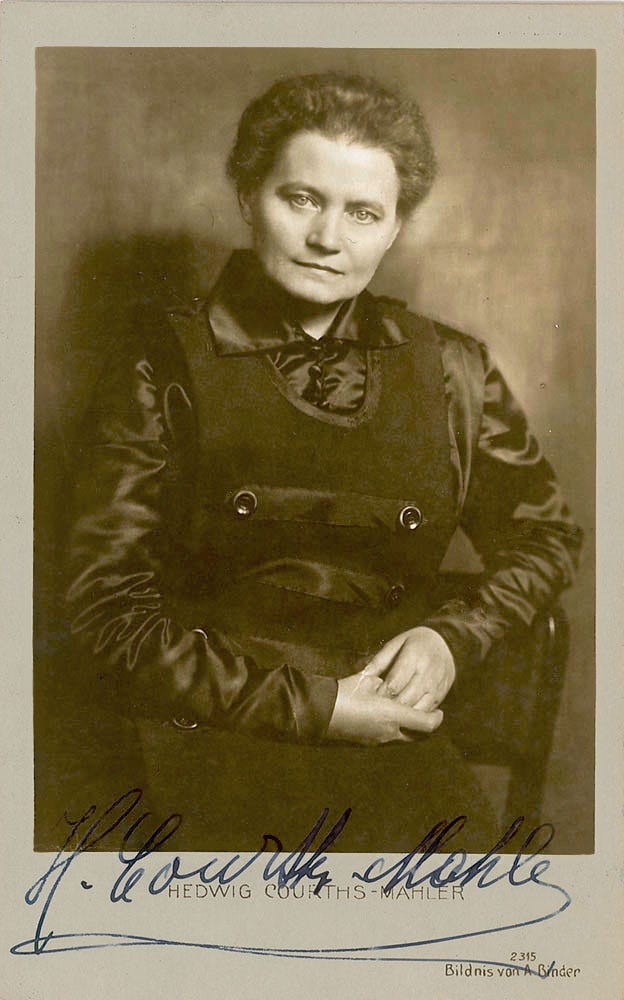
Besides her success story, there are three facts that I find particularly interesting about her. Based on the German National Library’s data, she is:
She was a very prolific author, with 170 original works (!) and 374 translations.
The publishing places of her translations are geographically specialized, meaning that 88% of her titles have been published in Budapest, Katowice, Warsaw, Brno, and Riga (the rest in Zagreb, Belgrade, Vilnius, Prague, Plovdiv, Wrocław, Bratislava, Gabrovo, Poznan, Aizkrauklē, Białystok, Bydgoszcz, Łódź).
Considering her success, how come then, that her name was never mentioned to me during my 8 years of studying German literature, and has not been on any school reading lists I have sifted through looking for women writers?
We can look at this case from two perspectives that may reveal some of the factors behind Courths-Mahler’s underrepresentation: first, the tendency for commercially successful literature to be excluded and disregarded in canonical studies and in literary education. This would explain why she is not on any high school or university reading lists. Upon a deeper dive into the literature on her, I discovered that the fact that her work was labeled “Kitsch”, popular fiction, “entertainment” literature (Unterhaltungsliteratur), or even “courthsmahlerisch”, therefore devalued and excluded from what was deemed canon-worthy. As a response, scholars such as Jones et al. (2015) have pushed toward re-examining her work from a socio-psychological standpoint, which sheds light on the role of women in society, social aspects of marriage and motherhood, as well “femininity and the female body during the interwar period”.4 While there is much to be said about the importance to add works that reflect on these issues to reading lists as well as why these topics are discarded as “Unterhaltungsliteratur”, I want to briefly address the elephant in the room: how women writers have been marginalized.
As I illustrated at the beginning, there is a persisting gender gap in reading and bestseller lists, so even though Courths-Mahler has an astonishing number of publications in the DNB, it does not correspond to how little she is discussed in scholarly work. Nicole Seifert has discussed one factor contributing to these imbalances in her book “FRAUEN LITERATUR: Abgewertet, vergessen, wiederentdeckt (2021) [literally, WOMEN’S LITERATURE: Devalued, Forgotten, Rediscovered], who argues that women’s writing has been systemically left out of reviews, canons, and anthologies. Interestingly, Seifert does not mention Courths-Mahler; however, she can be seen as an example of the systemic issues that underlie her invisibility. From these two perspectives, investigating her role in expanding the reach of translated German literature becomes even more compelling.
Hedwig Courths-Mahler’s translated languages and connection to Hungarian
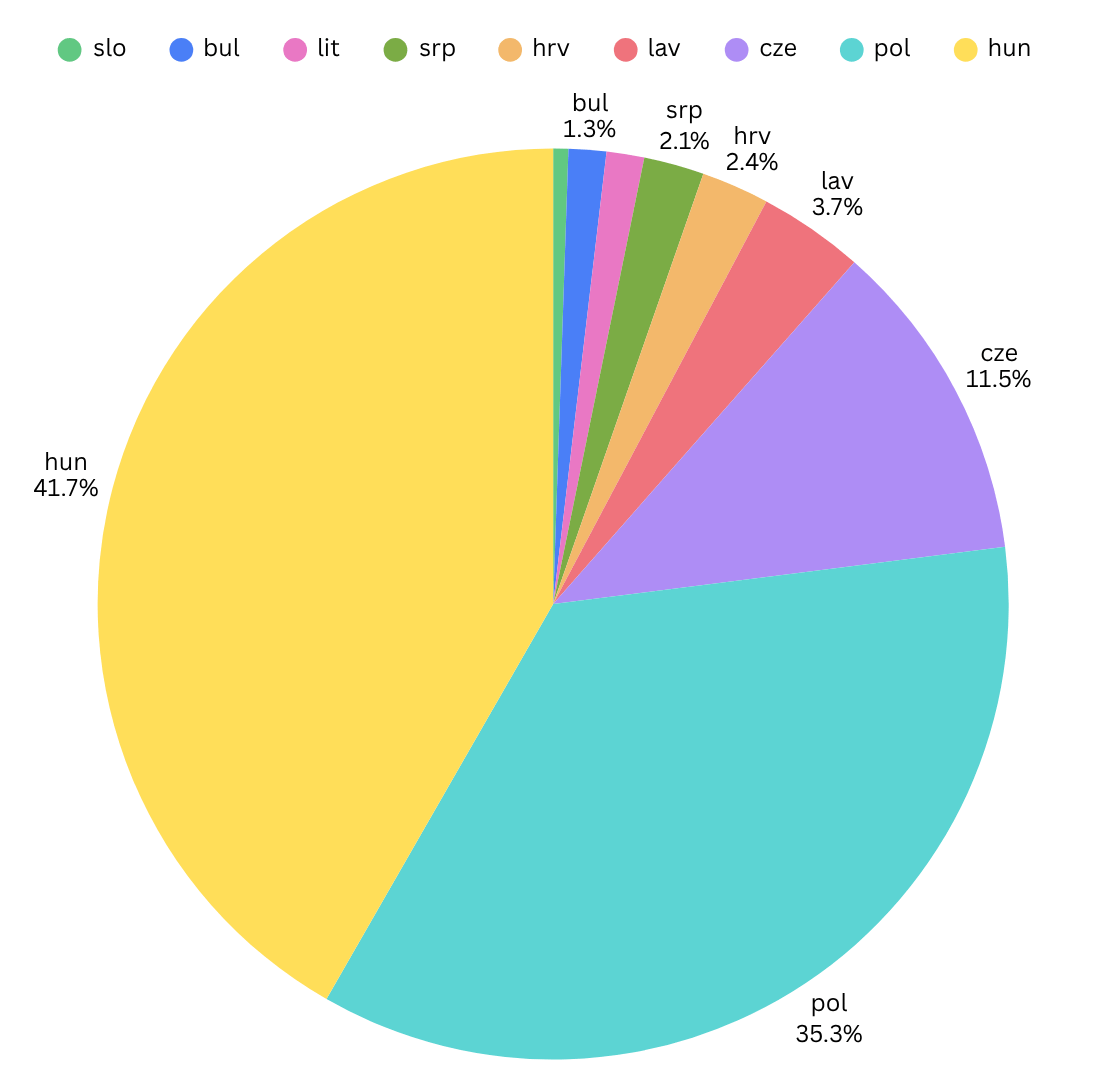
Looking at both her translated languages and publishing places reveals a strong connection to Hungarian. 41% of her translations are into Hungarian, followed by Polish, and Czech. Her two most prominent Hungarian publishers are Bastei Budapest Kiadó, which was most active between 1992 and 2002 and afterwards EX-BB Kiadó, which specialized on contemporary literature in translation and romantic fiction and published the last book by her in Hungarian translation (Frau Bettina und ihr Söhne) in 2015. Her works appear to still be on the market until now with her latest translation into Hungarian published last year. This underlines the importance of Hungarian as the eighth language with the most translations of German fiction by women writers and its importance for German fiction to reach beyond its linguistic boundaries.
Making women writers’ roles in translation visible
Hedwig Courths-Mahler’s case not only made me discover her as an author, but also illustrates the role certain authors play in connecting readerships across national boundaries. It illustrates that there exists a complex network of literary transfer, in which women writers have been influential actors, beyond central languages and the male canon.
I hope to illustrate that utilizing bibliographic translation data allows us to look beyond the gender gap and discover women writers beyond the national canon. This work may enable us to counter some of the tendencies that invisibilized women writers and inspire scholars of literature as well as readers to reflect on the roles of women writers in bridging literary communities and make visible the diversity of their translational trajectories.
Where to discover women writers
“Women in Translation Month” is one of many initiatives to increase visibility of women writers and translators by featuring new translations, translators’ commentary, and critical pieces on the canonization of literature. diekanon.org compiles lists of underrepresented authors, therefore creating an anti-canon of women writers. Frauenzählen (“Counting women”) is an initiative to reveal gender gaps in booklists etc.
Which women writers in the top 10 have you read and in which language?
Check out Lisa’s substack:
see report by Rüdiger Wischenbart et al. (2019, 27)
For a detailed discussion of all top 10 authors please see Teichmann, L. (2025). Translationalism and the gender gap in the German National Library: A case study for women writers. Feminist Translation Studies, 2(2), 153–173. https://doi.org/10.1080/29940443.2026.2674686
see Silbermann, A. (1993). Von der Kunst, unterhaltsam zu schreiben. Die Liebe bei Hedwig Courths-Mahler. Internationales Archiv für Sozialgeschichte der deutschen Literatur, 18(1), 69-85. https://doi-org.uaccess.univie.ac.at/10.1515/iasl.1993.18.1.69)
Jones, C., Cowan, M., & Sicks, K. M. (2015). More than skin deep? Ideals of beauty in the romance novels of Hedwig Courths-Mahler. In Leibhaftige Moderne (1. Aufl., S. 231–242). transcript Verlag. https://doi.org/10.14361/9783839402887-014)
 | A guest post by
|
Thank you for this article! Christa Wolf is one of my favorite writers of all time, and I've had the honor of reading her both in German and in the Italian translations made by Anita Raja, who does such a great job at translating the complexities of Wolf's language. I've just recently started reading some of Hertha Müller's works, and I have Bachmann's Malina on my nightstand right this very moment. Can't wait to get to it :)
In Italy we have a writer, Carolina Invernizio, which suffered the same literary fate as Courths-Mahler. What's interesting is that they wrote about similar topics and in Italy they both appear under the same imprint, one in re-print and the other in translation. Just a not-so-fun fact to show how pervasive this type of literary sexism truly is.
I appreciate your research. Thank you. For me: Hertha Mueller. Quite demanding but honest.