
Second World literature
Cold War translations, part 1.
This is the first in a series of posts. Part 2 is here, Part 3 here, the rest is still forthcoming.
For someone interested in world literature as a system (that is, crudely, in how literature circulates beyond its context of origin, and how that circulation adds up to a global network of translation flows), the Cold War might perhaps be the most fascinating period.
During the decades of the Cold War, an already robust worldwide commerce of books was both supplemented and countered by cultural-political efforts on a global scale. With the rise of the US to global domination, English had emerged as the contender for centrality in the world system of translations. At the beginning of the period, it was already the largest source language of literary translations into French, for example, and by the end, it was globally dominant. This historical transformation, in which London and then New York replaced Paris, was complicated by the Soviet Union and its efforts to create a communist world literature. For almost half of the 20th century, the literary system not just of Europe but of the world as a whole, is defined by this cultural confrontation between the first and the second world, and by their efforts to align the rest of the world with their interests.
How the conflict of political systems affected literary production and critical thought has been widely discussed. The political opposition between realism and modernism, between Thomas Mann and Joyce or Kafka, and in theoretical terms, between Lukács and Brecht, of course defined the literary universe of the second world. The same opposition also helped define the literary universe from the perspective of the first world and of the third world. If (critical) realism was the ultimate literary expression of the humanist tradition that socialism stood for, modernism became the consummate expression of the freedom of the western individual. Funding streams from the Soviet-supported World Peace Council and the CIA-front Congress for Cultural Freedom helped turn not only ideological commitment but also aesthetic autonomy into political tools across the globe. The choice between those positions was a choice between worlds. That is to say, the Cold War was not only a political conflict between two worlds which also tore through a third: it was a conflict in which the very definition of the world was at stake.1
The conflict seemed to have ended with the collapse of the Eastern Bloc.
Literary history by the victors
From the perspective of what passes for mainstream anglophone scholarship about world literature, which is to say, what passes for mainstream scholarship about world literature, the literary universe of the second world disappeared without almost a trace. From an Atlantic perspective, it never actually existed, except in the writing of dissidents and exiles, eager or unwitting allies in the cultural-political effort to contain or defeat it. And now people have generally lost interest even in them. This is partly an unthinking survival of the configuration Werner Friedrich in 1964 called “NATO literature.”2 Joining the military alliance was obviously not enough for the literatures of communist East and Central Europe to be retrospectively incorporated in its literary canon. Looking at bookshelves and scholarship, it seems like those forty years never happened. Not only socialist realist propaganda, but also all the effort to write against it, or to make something useful out of it. Crossed out.
The rise of world literature as a field of study coincided with the 1990s euphoria over the end of history, and that moment of origin clearly left its mark. The big scholarly compendia that have now begun to appear, synthetizing a quarter of a century of discussion since the 1990s, suggest that while the third—postcolonial—world is now receiving the kind of attention it was previously denied, the second world continues to be more or less systematically bracketed out from the world of world literature.
Of the single page (!) devoted to literature “beyond the iron curtain” in the 2022 multi-volume, 1800-page Literature: A World History (ed. Damrosch et al.), more than a third covers Yugoslavia, a founder of the movement of non-aligned countries, the whole point of which was to not be on either side of the iron curtain. The remaining two short paragraphs discuss three exiles: Márai, Solzhenitsyn, and Kundera. People who left.3
The 2021 Cambridge History of World Literature has substantial discussions of Russian and communist influence in South Asia and East Asia during the cold war, but not a word about the post-WW2 Eastern Bloc itself, where that influence was coming from, either as a place of production or of circulation. It’s like Europe’s Cold War never happened, and the world that lost the Cold War never existed.4
World literature is the literature of one world: of the first world, as it expanded. Beyond its borders, the outer darkness.5
Ambitious European surveys are only marginally more helpful, written as they are from the perspective of American world-literary hegemony.6 Sandra Richter’s celebrated world history of German literature cannot quite avoid dealing with the awkward fact of East Germany, the country not only of Brecht and Seghers, but also of Christa Wolf, Stefan Heym, Heiner Müller, and Jurek Becker, so it devotes to it twelve pages out of 480.7 But she only touches minimally on the reception of German literature in Eastern Europe, where German literature’s influence was arguably deepest and most consequential, while the English-language reception receives seemingly exhaustive treatment. Na ja.
Central languages of a lost world
Can numbers force us to see things we otherwise don’t?
There is a body of research that applies a crude version of world systems analysis to translation flows, tracing a historically evolving, hierarchical world system of translations. Such research talks about centers and peripheries: in the world system of unequal flows, translations primarily flow from centers towards peripheries. The more books are translated from a language, the more central it is to the system.
Across Europe and most of the world, English has been the most important source language of translated publications—more than half of all books translated worldwide are now from English, and their share continues to grow. English has in this sense been “super-central” to the literary world system for decades. As source languages in the global circulation of translations, German and French are central languages, whereas Spanish, Italian, Russian are semi-central—Russian having declined from a central position after 1989. (We discussed the hierarchy of languages, and the super-centrality of English, in an earlier post.)
Obviously, the central position of Russian, at times comparable to German or French, was a function of its centrality to the Second World.
The historically changing centrality of English, French, Russian, and German can be seen in this graph about translations into Hungarian during the Cold War, based on data published by the Hungarian Bureau of Statistics:
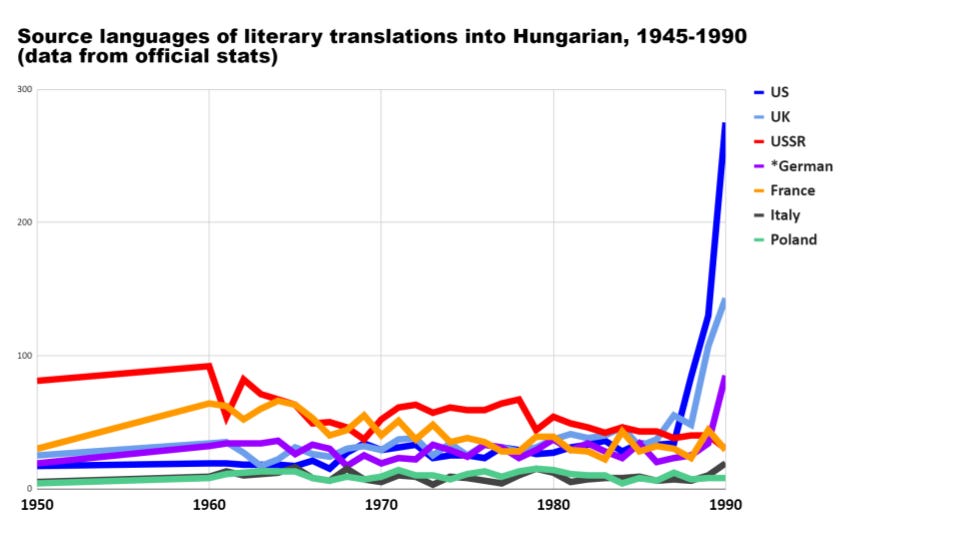
In Hungary, Russian clearly dominated among source languages during the Stalinist period. (The data for that decade is only available as an aggregate, not year-by-year—hence the straight line. Our numbers for 1950 are the averages of the years 1950-1959.) Its presence then gradually diminished. French recovered after the Stalinist years, only to decline as translations of American books began to take off. A sudden increase in translations from Anglophone literatures marks the end of the era. (An increase in the number of books from German at the same time signals an increase in the number of west-German—and Swiss and Austrian—authors.)
This is an image of the Russian-dominated cultural world of the eastern bloc. The centrality of Russian was clearly a feature of Second World Literature—it can be observed across the bloc, while it is obviously not something that characterizes the North Atlantic world, or Latin-America, except maybe Cuba. The gradual decline and then collapse of Russian as a source language coincides with the sudden explosion of translations from English—again, clearly something comon across the now former Second World. That explosion was the combined effect of the global rise of English to super-central position in the second half of the 20th c., and the local reconfiguration of translation flows at the end of the Cold War. The liberalization of publishing that begun in the late 1980s—a few years before the system would have collapsed—meant lifting the limitations that were imposed on the translation of English and American works, imposed not least in order to maintain the dominance of Russian at least in terms of the number of titles published. (In terms of copies sold, American books already surpassed Russian much earlier: in 1980, for example, 27 American and 54 Soviet titles were published—the former in 1,658,100 copies, the latter in 924,100 copies.8)
When Lolita appeared in Hungarian in 1987, you knew the Cold War was about to be over.9
World literature from behind the Iron Curtain
The metadata of literary translations from Hungarian published between 1947-1989 can be used to reveal how the competition between the two political systems shaped the flows of translations.
The metadata ultimately always reflect something about the data: in this case, the bibliographical information reflects something about the works themselves, about their political and also about their aesthetic qualities. Earlier we looked at the circulation of two authors, Milán Füst and Géza Gárdonyi, and showed how genre and aesthetics informed the trajectories of circulation. But now, just the metadata of translations from Hungarian into other languages, and what they allow us to see about the system of Second World Literature—in terms of flows between countries or languages, and how they constitute a system.
In terms of total numbers, between 1947-1989, we have records of about 1500 books published in the First World, 3000 published in the Second World, and about 500 in the Third World. (We may be missing somewhere between 5-30% of all titles published; there are big variations in the coverage according to country and time period.)
German is the largest target language for Hungarian writing throughout this history. But the Iron Curtain made sure that there is no real point in treating translations into German as a single set, for example. In our exploration of the circulation of Hungarian literature across the two world systems, our unit of analysis is what we call a region. Regions are political units with a clearly identifiable dominant language: most of them are countries, but Slovakia and Czechia, and the republics of the Soviet Union are also considered here as separate regions, as are of course West Germany and East Germany.
The Cold War was a period in which Eastern European nations were forced to learn about each other’s literatures. The chart below shows the number of publications appearing in the largest target regions for Hungarian literature in translation. The regions with more than 300 books over the period are all in Eastern Europe. Although below the threshold, in the 7th place, we also include West Germany, the region with the largest number of translations from Hungarian literature in the First World.
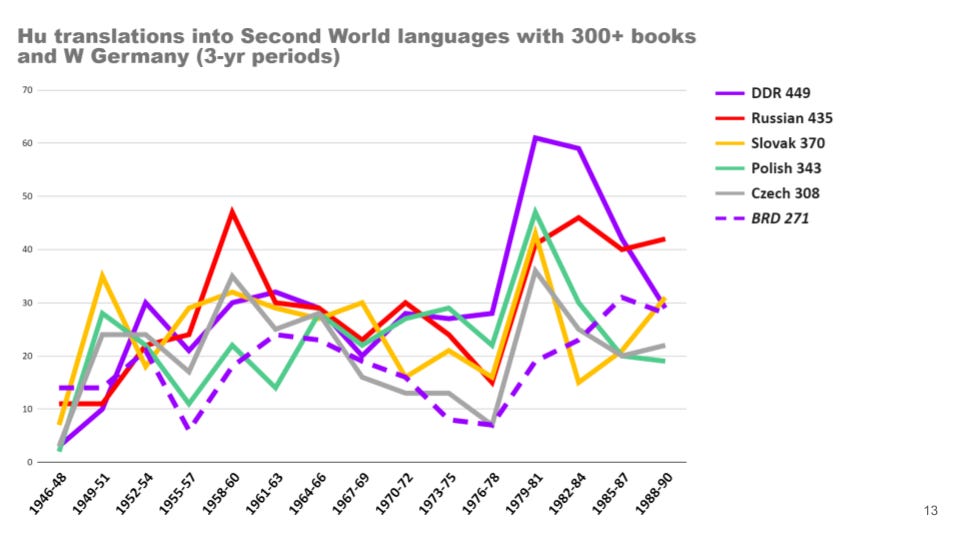
Not only are the numbers for this group of five Eastern-European regions pretty close to each other: they are also moving together through much of the period. There is a moment when the flow to Russian expands, and another moment when the flow to East Germany starts to grow—otherwise, the differences are not consistent, the lines criss-cross. This balanced circulation was obviously the product of careful bilateral coordination among the communist countries. Those mechanisms, and the literary circulation engineered by them, are what disappear at the end of the 1980s.
After an expansion starting in the late 1970s, the end of the 1980s brings a decline, which becomes more precipitous after the 1990 cutoff-point. Publishing underwent a radical transformation during the 1990s: although the total number of copies sold continued to decline, the number of titles published increased. In spite of that general trend, translation flows among the former Second World countries never reached the levels they were at in the 1980s.
Interconnected worlds
What can we say about the different images of Hungarian literature that these translations convey or produce? How big a difference is there between the First World and the Second World version of Hungarian literature? To see this, we analyzed the metadata of the translations as a network.
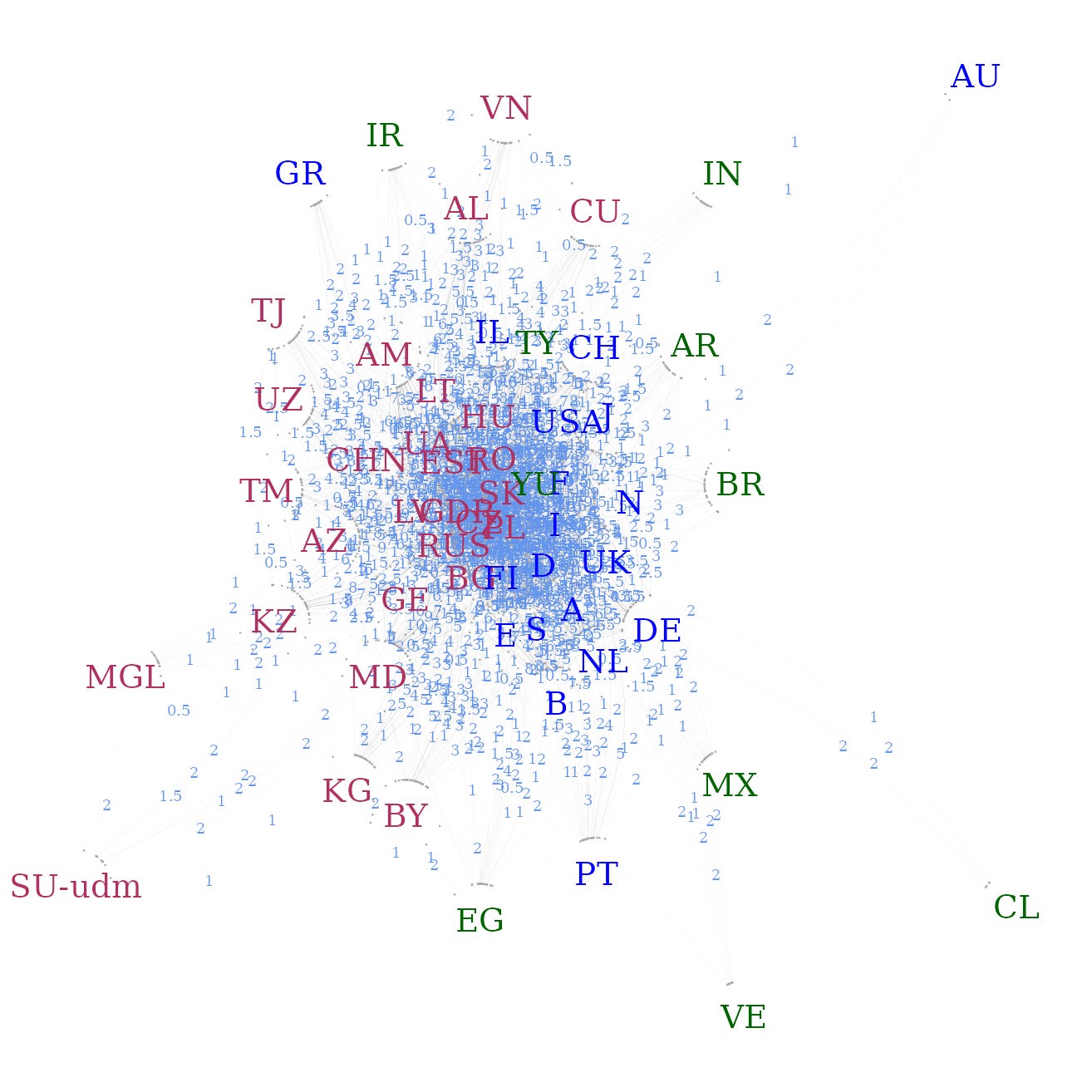
This is a network of translations from Hungarian during the cold war. The nodes of this network are regions: language-markets, languages as political units. So not English, but UK or USA or AU. Not Czechoslovakia, but CZ and SK. Not USSR, but RU, UA, GE, EST, LV, LT, KZ, UZ, TM, TJ, AZ, AM, KG, BY, etc.
Note the node labeled HU. (It should have been H, actually: we were using the country car registration codes, the ones that used to be in the oval label or plate—in most countries, they have now been integrated into the license plate.)

Hungary appears as a node in the network because of the significant number of translations published into other languages there. Although such domestic translation for export can occasionally happen anywhere, the case of Hungary was unique, with a major publishing house (Corvina) created for this purpose.
Edges in the network represent the similarities among what was translated in each region. They are weighted (the numbers are not easy to see, but they are there): the weight of each edge is the number of authors translated in both regions. So if Petőfi was published in both regions, the weight of the edge is one. If Péter Nádas was also translated in both, it is two. Authors only published in a single region thus make no difference to this visualization. The above visualization only includes edges with a weight of at least two. So one shared author is not sufficient to appear as an edge, and nodes with no edge with the weight of at least 2 do not appear.
We color-coded the regions according to the world system they belong to: blue is first world, red the second world, green the non-aligned countries or “third world.”10
Here is a network where edges weigh at least 10. (The numbers might be confusing: the nodes are actually connected with directed edges, where the direction of the edge reflects the chronology of publication—this will become relevant only later on. But where you see an edge with the number 8, it has a pair in the opposite direction: the sum of the two has to be 10 or more.)
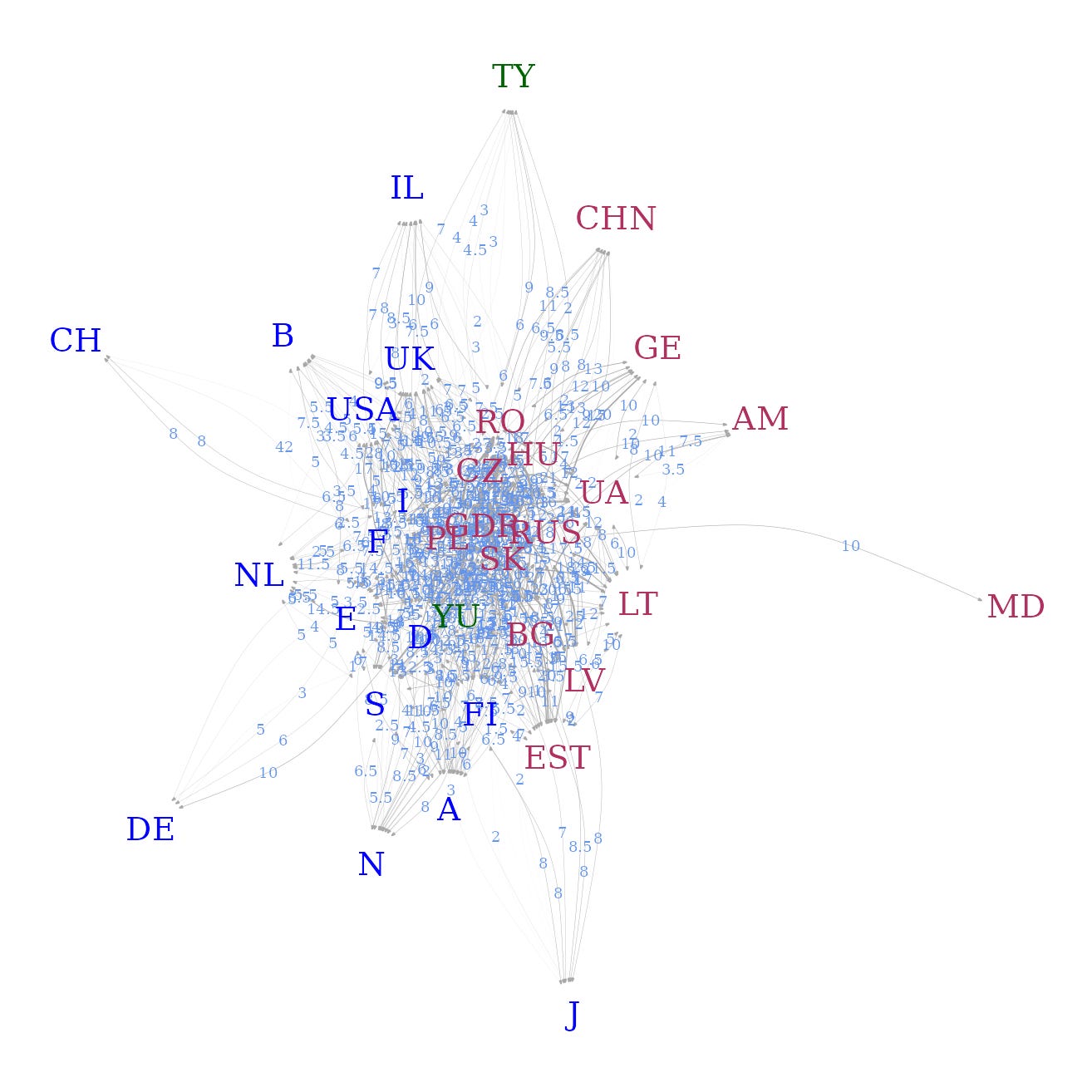
The program we are using to visualize this network automatically organizes the nodes based on these connections. Regions with more shared authors are closer to each other.
A glance at the result reveals that the network falls into two, closely connected halves—blue and red. The important point is: we did not organize the network like this: their connections did.
The differences between what authors circulate in the East and in the West, the authors shared among First World countries and among Second World countries organize the network so that nodes belonging to the same political system end up closer together. A look at the strongest links—the skeleton of the network, the edges with a weight of at least 20—shows how closely the corpora of West German, French, and Italian translations are aligned with the Eastern-European selections.
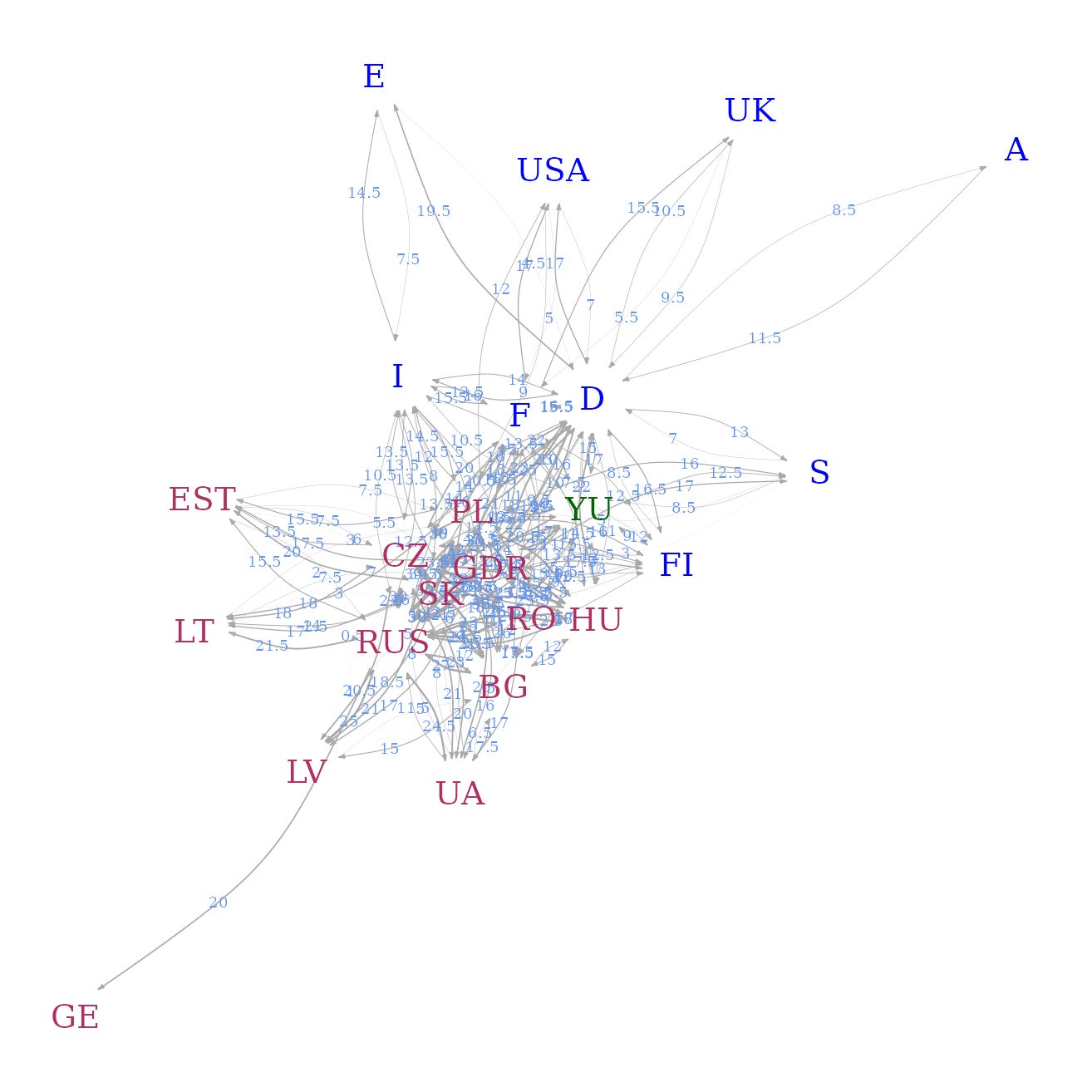
But the two worlds are not cut off from each other. They form a single network. The central nodes of both the blue and the red half are in fact closely interconnected. So the sets of authors circulating in First and Second World countries are not identical, but the overlaps are huge. Although the shape of Hungarian literature on the two sides of the Iron Curtain was not the same, the canonical emphases were different, and there were authors appearing only on one or the other side—yet Hungarian literature was recognizably similar in both worlds.
In our next post, we will look more closely at the internal structure of the system as a whole, and at the structure of Second World Literature: the world-literary subsystem of the second world.
The work of Sorin Cucu and Roland Végső has helped us understand this.
“NATO-literature . . . from ancient Greece through the Mediterranean and German literatures to the modern Anglo-Americans,” Werner P. Friedrich, “Great Books Versus ‘World Literature’.” in Friedrich, The Challenge of Comparative Literature and Other Addresses, ed. William J. DeSua, University of North Carolina Press, 1970, 29–35, at 30-31, quoted by Vilashini Cooppan, “World literature after 1989: revolutions in motion,” in Debjani Ganguly (ed.) The Cambridge History of World Literature, 180-198, at 188.
Literature: A World History, ed. David Damrosch and Gunilla Lindberg-Wada. Wiley Blackwell, 2022, vol 4., p. 1503.
Checking the mentions of the maybe half a dozen Eastern Bloc authors active between 1947-1989 who are listed in the 52-page index, only Kundera receives more than a mere mention in a list of names, and only for his ideas about regionality, not as an author of literary texts. 2 vols., ed. Debjani Ganguly, Cambridge: Cambridge University Press, 2021.
The Russian writing of periods when Russia is more integrated into the west is in—what might be happening in Russia in periods when it is not, is enveloped in the cloud of unknowing.
There is of course specialized scholarship, both in Eastern Europe and beyond. Ioana Popa’s excellent book, which examines the system of Cold War French translations of Eastern European literatures reveals a lot about Cold War world literature, but since it studies what got out from behind the Iron Curtain, it naturally cannot say much about what happened inside.
Eine Weltgeschichte der deutschsprachigen Literatur. C. Bertelsmann, München, 2017.
In 1980, in this country of 10 million, the 27 American titles were published and sold in 1.7 million copies. Hungarian literary titles were sold in a total of 10 million copies, and translated literature, all languages included, 7.6 million copies.
One aspect of the Cold War problem that Lolita was is well described from one perspective by Jed Esty, After the West: Conrad and Nabokov in Long-Wave Literary History. PMLA 137/5 (2022):779-794. The reading of Lolita not only as a journey “into the heart of Anglo-American darkness,” but of Nabokov as a novelist who could “stand for Western freedom while delivering such a scathing takedown of its myths” is confirmed by him being on the Index in the Second World side by side with Orwell.
Our data does not yet allow us to parse our Yugoslav corpus into its constituent regions, as our approach would require. Political changes over the period also make the color-coding of some non-aligned countries open to debate.
"Of the single page (!) devoted to literature “beyond the iron curtain” in the 2022 multi-volume, 1800-page Literature: A World History (ed. Damrosch et al.), more than a third covers Yugoslavia, a founder of the movement of non-aligned countries, the whole point of which was to not be on either side of the iron curtain."
Something similar, though not exactly analogous, happens in art history survey books. There has been pressure to 'globalize' survey courses, so recent books have multiple chapters on Oceania, Mesoamerica, etc. But there's one part of the world that seems inevitably to be left out. Looking at a recent two-volume textbook (Thames and Hudson, 2021, 1248 pages) I find the following on Eastern Europe:
p. 479: "Finally, Russians, converted by the Byzantines and led by a tsar (caesar), strove to make Moscow into a Third Rome."
p. 672: "In the fifteenth century, many German artists moved east, outside the Holy Roman Empire, to work in the Christian kingdoms of the Czech lands, Poland, Lithuania, and Russia, where rulers declared Moscow the 'Third Rome.' The city of Kraków was the capital of the kingdom of Poland and an important academic and economic center. There, German merchants and artists worked with the nobility to bring a high level of splendor to the city, creating an international hub." [this is followed by two paragraphs on Veit Stoss's altarpiece for St. Mary's Basilica in Krakow.]
p. 1074: "Kandinsky, a native of Russia..." [four paragraphs on Kandinsky follow]
pp. 1128–32: Malevich, Stepanova, Rodchenko, Tatlin and the advent of Socialist Realism (which, however, is not illustrated here, but only in the later section on the PRC)
So at least in this textbook, it's not a question of 'Iron Curtain' Eastern Europe receiving minimal attention, but rather, apart from Russia in the 1920s, the region does not exist.
To be fair though, the same holds true for the rest of the European periphery. There is no Portuguese art, only Sub-Saharan African art depicting the Portuguese. And Sweden turns up once, in the Rococo chapter, for its 'Chinese Pavilion'. ("Under the pretense of leisure and sociability in a garden setting, the queen presented Chinese culture as something that could be naturally subsumed within that of Europe." p. 919)
I guess all this is inevitable if the trend for 'Global Art History' is seen as a reaction to Eurocentrism. Additional chapters on art in Poland, Russia, Portugal and Sweden would make a survey book more global in scope, but also more Eurocentric.